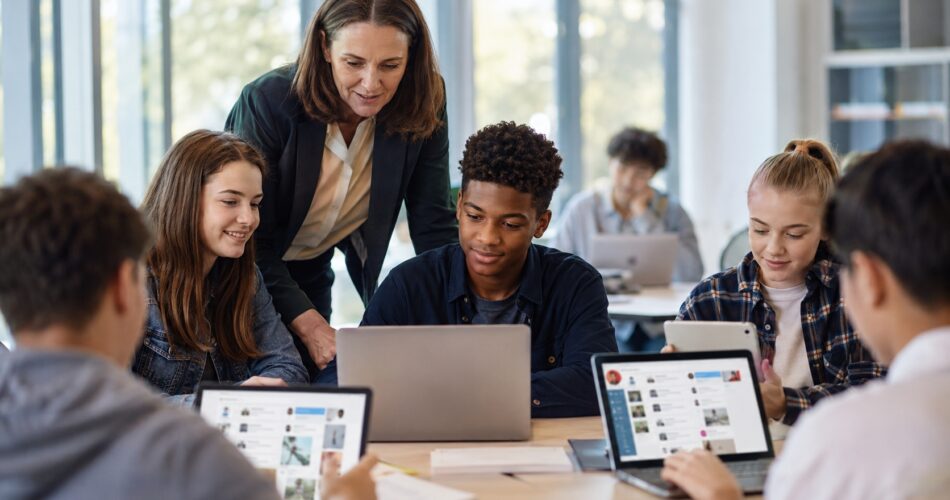
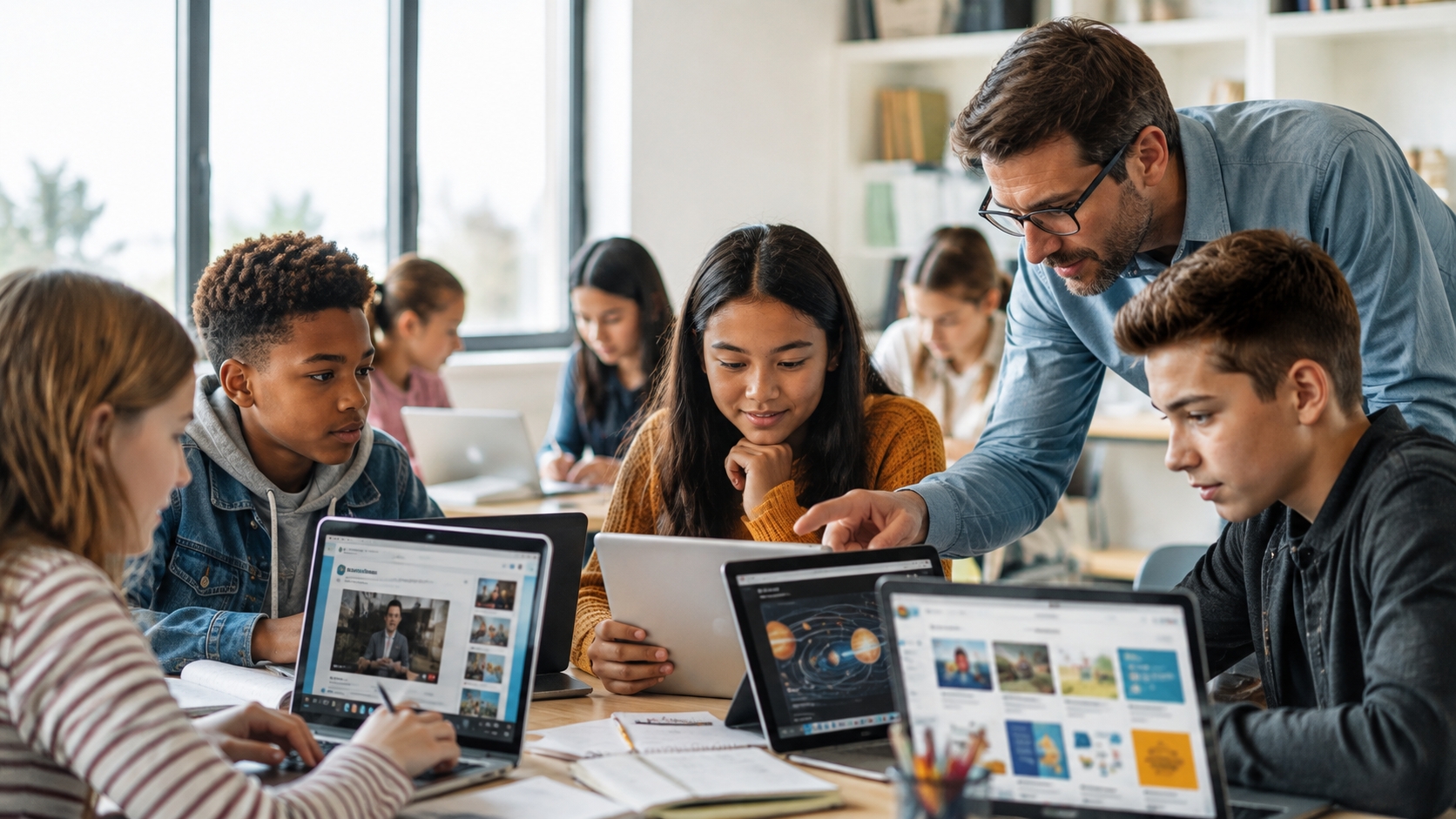
Social media can be useful in education when it is connected to a clear learning objective. Instead of treating social platforms as a replacement for a learning management system, teachers can use them to find relevant resources, communicate with learners, support collaboration, and give students opportunities to create and share knowledge.
The most effective approach is not to use social media simply because it is popular. The platform, activity, and level of supervision should match what students are expected to learn.
Key takeaways
- Social media can support content discovery, communication, collaboration, and student-created work.
- Students can use social platforms to practice critical thinking, information literacy, creativity, and communication.
- Teachers should consider reliability, privacy, accessibility, age suitability, and platform policies.
- Social media should support learning objectives rather than become the objective itself.
How can social media be used in education?
There are several ways to use social media in education. They can be grouped into three broad categories:
- Find and curate useful educational content that teachers can use directly in lessons.
- Support communication and learning communities between teachers and students and among students.
- Give students opportunities to create and share content individually or collaboratively.
These categories overlap. For example, a teacher may discover a useful video through a professional community, share it with students, and then ask students to discuss or respond to it in a class activity.
1. Use social media to find relevant educational content
Social media can act as a large, constantly changing source of examples, explanations, discussions, images, videos, and professional perspectives. Used carefully, it can help teachers bring current and relevant material into lessons.
Find videos and demonstrations
Video platforms can provide demonstrations, lectures, interviews, experiments, tutorials, and explanations that complement classroom instruction. Teachers can select a short video to introduce a topic, demonstrate a process, or provide an alternative explanation.
Before sharing a video, check its creator, publication date, evidence, context, and suitability for the learning objective.
Find photographs and visual examples
Photographs shared through social platforms can provide useful examples for subjects such as history, geography, science, art, media studies, and current events. Visual material can help students connect abstract concepts with real-world situations.
Teachers should also consider copyright, licensing, attribution, privacy, and whether an image can legally be reused.
Follow educational blogs and professional communities
Teachers can follow educators, researchers, institutions, professional organizations, and subject-specific communities to find lesson ideas and discussions. Social networks can also expose educators to different teaching approaches and perspectives.
Following a source does not automatically make every post reliable. Students should learn to distinguish evidence-based information, professional opinion, personal experience, advertising, and unsupported claims.
2. Use social media to support communication
Social platforms can support communication outside scheduled lessons, especially when students already understand the underlying communication format. A class community can be used for reminders, questions, discussions, resource sharing, and peer support.
Private class communities
A dedicated private group or community can provide a space where teachers share assignments, deadlines, announcements, supplementary resources, and discussion prompts. Students can ask questions and help one another without every interaction having to happen during class time.
Privacy and boundaries matter. Teachers should follow institutional policies, avoid unnecessarily mixing personal and professional accounts, and choose platforms appropriate for the students’ age and context.
Discussion and peer support
Social-style discussion can make it easier for students to exchange ideas, compare viewpoints, and provide peer feedback. Instead of simply asking students to comment, give them a meaningful task such as identifying an assumption, comparing two viewpoints, explaining a concept, or asking an evidence-based follow-up question.
Professional networking
Professional social networks can help university learners and professionals build connections related to their field of study. Students can follow organizations, subject experts, employers, and professional communities while learning how to communicate appropriately in a professional environment.

Professional networking can also continue after a course ends, allowing students to stay connected with classmates, mentors, instructors, and people working in their field.
3. Involve students through social media projects
Social media becomes more educationally valuable when students move from simply consuming information to creating, evaluating, and communicating ideas.
Develop information literacy and critical thinking
Students encounter a mixture of reliable information, incomplete information, personal opinions, commercial content, satire, and misinformation online. Teachers can turn this environment into a structured learning activity.
For example, students can compare two posts about the same topic and identify the author, evidence, publication date, purpose, supporting sources, and missing context. They can then explain which claims are better supported and why.
Develop creativity
Students can use social media formats to communicate what they have learned. Depending on the subject, an assignment might involve producing a short educational video, creating a visual explanation, preparing a photo-based field report, writing an informative post, or developing a collaborative digital presentation.
The format should serve the learning goal. A creative assignment should still require students to demonstrate knowledge, reasoning, research, or communication skills.
Encourage authentic communication
Publishing work for an audience beyond the teacher can encourage students to think more carefully about clarity, evidence, structure, and presentation. However, public publishing is not appropriate for every student or assignment. When privacy matters, the same activity can be completed in a private class community or another controlled environment.
Examples of student-created projects
- Create a short video explaining a concept learned in class.
- Publish a researched article or reflection on a class blog.
- Create a visual report from fieldwork or an experiment.
- Prepare a social-media-style presentation that summarizes a historical event or scientific concept.
- Collaborate with classmates to produce an educational resource for future students.
- Review and fact-check selected online claims related to the course.

Benefits of using social media in education
Familiar communication formats
Students may already understand communication formats such as short posts, comments, video, images, and online communities. Familiar formats can reduce the learning curve for some activities.
More opportunities for collaboration
Social platforms can make it easier for learners to exchange ideas, provide peer feedback, share resources, and work together outside the physical classroom.
Access to diverse perspectives
Students can encounter perspectives from different communities, professions, locations, and backgrounds. With appropriate guidance, comparing these perspectives can become a useful critical-thinking exercise.
Real-world communication skills
Creating content for an audience can help students practice concise writing, visual communication, research, presentation, digital etiquette, and audience awareness.
Learning beyond the classroom
Social media can extend discussions beyond scheduled class hours. Students can follow relevant organizations, continue conversations, and find additional resources connected to their studies.
For broader learning strategies, see our guide to different learning methods and our collection of online education resources.
Criticisms and limitations of social media in education
Social media is not automatically an effective educational tool. Its value depends on how it is selected, structured, and used.
Information quality and misinformation
Social platforms can contain inaccurate, misleading, outdated, or deliberately false information. Students need guidance on source evaluation, evidence, context, and verification.
Distraction and reduced attention
Social platforms can contain notifications, recommendations, advertising, and unrelated content that compete with the learning task. A lesson should define when students should use the platform, what they should look for, and when they should stop.
Privacy and digital safety
Students may have different levels of comfort with public posting and may not want schoolwork associated with a personal account. Educational activities should minimize unnecessary exposure of personal information and follow institutional privacy and safeguarding requirements.
Unequal access
Not every student has the same device, internet connection, account access, digital skills, or home environment. A social-media-based activity should have an accessible alternative when participation depends on a particular platform or device.
Copyright and ownership
Images, videos, music, articles, and other material found online are not automatically free to copy or republish. Teachers and students should understand licensing, attribution, and the difference between linking to content and reusing it.
Platform changes
Social platforms can change their features, policies, privacy settings, algorithms, and availability. An educational activity should not depend so heavily on one platform that the lesson becomes unusable when the platform changes.
How teachers can use social media effectively
- Start with the learning objective. Decide what students should know, understand, create, or be able to do.
- Choose the activity. Decide whether students need to find information, discuss ideas, collaborate, create content, or evaluate sources.
- Select the platform carefully. Consider privacy, accessibility, age suitability, moderation, cost, and required skills.
- Set clear boundaries. Explain what students should post, where they should post it, how they should interact, and what information they should not share.
- Teach source evaluation. Show students how to check authorship, evidence, date, context, and supporting sources.
- Provide an alternative. Make sure students can complete the learning objective without being disadvantaged by lack of access to a particular platform.
- Assess the learning, not popularity. Evaluate research, reasoning, creativity, communication, or subject knowledge rather than likes, views, or follower counts.

Social media should support learning, not replace teaching
The strongest educational use of social media is purposeful. A teacher does not need to move an entire course onto a social platform to benefit from social technologies. A carefully selected video, moderated discussion, collaborative project, or source-evaluation exercise may be enough.
For beginners, structured activities are usually easier to manage than completely open-ended exploration. As students develop research skills and prior knowledge, teachers can gradually give them more responsibility for finding, evaluating, creating, and sharing information.
This also connects with broader digital learning. Students can combine social communities with other learning possibilities through social media, online courses, educational apps, and independent study.
Final thoughts
Social media can become a useful part of education when it has a clear purpose. It can help teachers locate resources, communicate with students, build learning communities, and design activities in which students create and evaluate information.
At the same time, educators should not adopt a platform simply because it is popular. Privacy, accessibility, misinformation, distraction, copyright, and platform changes all need to be considered.
The best approach is simple: start with the learning objective, choose the technology that supports it, and give students enough structure to use that technology responsibly.
Frequently asked questions
How is social media useful in education?
Social media can help teachers find educational resources, communicate with learners, build communities, support collaboration, and give students opportunities to create and share content.
Can social media improve student engagement?
It can support engagement when an activity is meaningful and connected to the learning objective. Simply placing an assignment on a social platform does not guarantee better learning.
What are the disadvantages of social media in education?
Potential disadvantages include distraction, misinformation, privacy concerns, unequal access, inappropriate content, copyright issues, and dependence on changing third-party platforms.
How can students use social media for learning?
Students can follow reliable educational sources, participate in moderated discussions, collaborate with classmates, evaluate online information, and create educational content.
Should teachers require students to use social media?
Not necessarily. The decision should depend on the learning objective, student age, institutional policies, privacy requirements, accessibility, and availability of suitable alternatives.