
Distance learning is a form of education in which students and instructors do not need to be physically present in the same classroom. Instead, lessons, course materials, communication, assignments, assessments, and support can be delivered through the internet and other communication technologies.
Today, distance learning can include live video classes, recorded lessons, discussion forums, self-paced courses, digital textbooks, online assessments, virtual classrooms, and collaborative learning activities. This flexibility makes it possible for students to learn from home, work, or almost any location with suitable internet access.
Distance education has evolved considerably from the traditional correspondence courses of the past. Modern digital learning environments can connect students with instructors and classmates around the world while providing access to a wide range of educational resources.
In this guide, you’ll learn what distance learning is, how it works, the main types of distance learning, its benefits and challenges, and how to choose a suitable distance learning system or course.
What Is Distance Learning?
Distance learning is an educational approach in which teaching and learning take place when students and instructors are separated by physical distance. Technology is commonly used to deliver course materials, communicate with instructors, participate in classes, submit assignments, and complete assessments.
Distance learning can take place entirely online or through a combination of digital and traditional learning resources. Depending on the course, students may participate in live classes, watch recorded lectures, read digital materials, complete assignments independently, or communicate with instructors through email and online discussion platforms.
The concept itself is not new. Traditional distance education included correspondence courses in which students received printed materials and communicated with educational institutions by mail. Modern distance learning has expanded this model through the internet, video conferencing, learning management systems, mobile devices, and other digital technologies.
UNESCO describes distance education as education delivered at a distance through communication technologies and other methods, including online learning and videoconferencing.
How Does Distance Learning Work?
A distance learning course normally combines several technologies and learning activities. The exact experience depends on the institution, instructor, course design, and level of study.
A typical distance learning course may include:
- Online lessons and course materials
- Live or recorded video lectures
- Discussion forums and messaging
- Digital textbooks and reading materials
- Assignments and projects
- Online quizzes and assessments
- Feedback from instructors or tutors
- Virtual group activities
- Progress tracking through a learning management system
For example, a student might watch a recorded lesson on Monday, participate in a discussion forum on Tuesday, complete an assignment during the week, and attend a live video session with an instructor on Friday.
Some institutions use a combination of online study materials, tutors, forums, and scheduled learning activities. The Open University, for example, describes its distance learning model as supported learning that combines flexible study with learning materials, tutors, online interaction, and student support. Learn more about how distance learning works at The Open University.
Types of Distance Learning
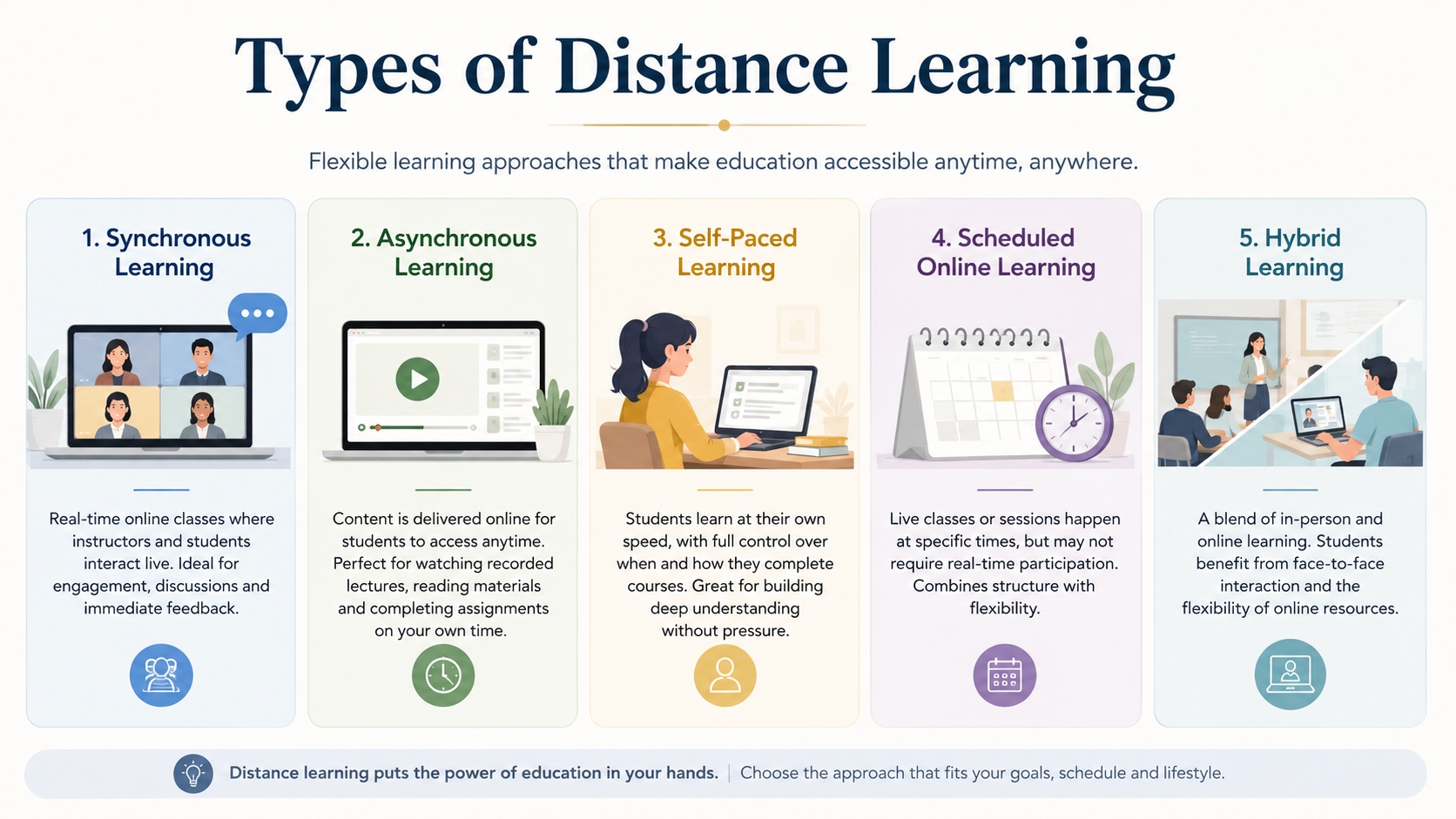
Distance learning is not a single teaching method. Different courses use different combinations of synchronous, asynchronous, self-paced, and hybrid learning.
1. Synchronous Distance Learning
Synchronous learning takes place when students and instructors participate at the same time, even though they may be in different locations.
Video conferencing is one of the most common examples. Students may join a virtual classroom at a scheduled time, interact with their instructor, ask questions, and participate in discussions with other students.
This approach provides more real-time interaction but requires students to be available at specific times.
2. Asynchronous Distance Learning
Asynchronous learning allows students to access course materials and complete learning activities without attending live classes at a particular time.
Students may watch recorded lessons, read course materials, participate in discussion boards, and submit assignments according to specified deadlines.
This format can be particularly useful for learners who have work, family responsibilities, or different schedules.
3. Self-Paced Online Courses
Self-paced courses give learners considerable control over when and how quickly they study. Some courses have recommended schedules, while others allow students to progress whenever they have time.
This format can work well for working professionals, independent learners, and people who prefer to study according to their own schedule.
4. Scheduled Online Courses
Scheduled online courses require students to participate in lessons or activities at predetermined times. They may include live lectures, webinars, examinations, group discussions, or instructor-led workshops.
The main difference from traditional classroom learning is that students can participate remotely rather than being physically present in the same classroom.
5. Computer-Assisted Distance Education
Computer-assisted distance education uses computers and digital learning systems to deliver lessons, activities, assessments, and educational resources.
Students may use learning management systems, educational software, interactive simulations, digital libraries, or other computer-based resources as part of their studies.
6. Hybrid or Blended Distance Learning
Hybrid learning, also called blended learning, combines online learning with selected face-to-face activities.
For example, students might complete lectures and assignments online but attend a physical campus occasionally for practical sessions, examinations, workshops, or laboratory work.
The exact balance between online and in-person learning depends on the course and institution.
Distance Learning vs Traditional Learning
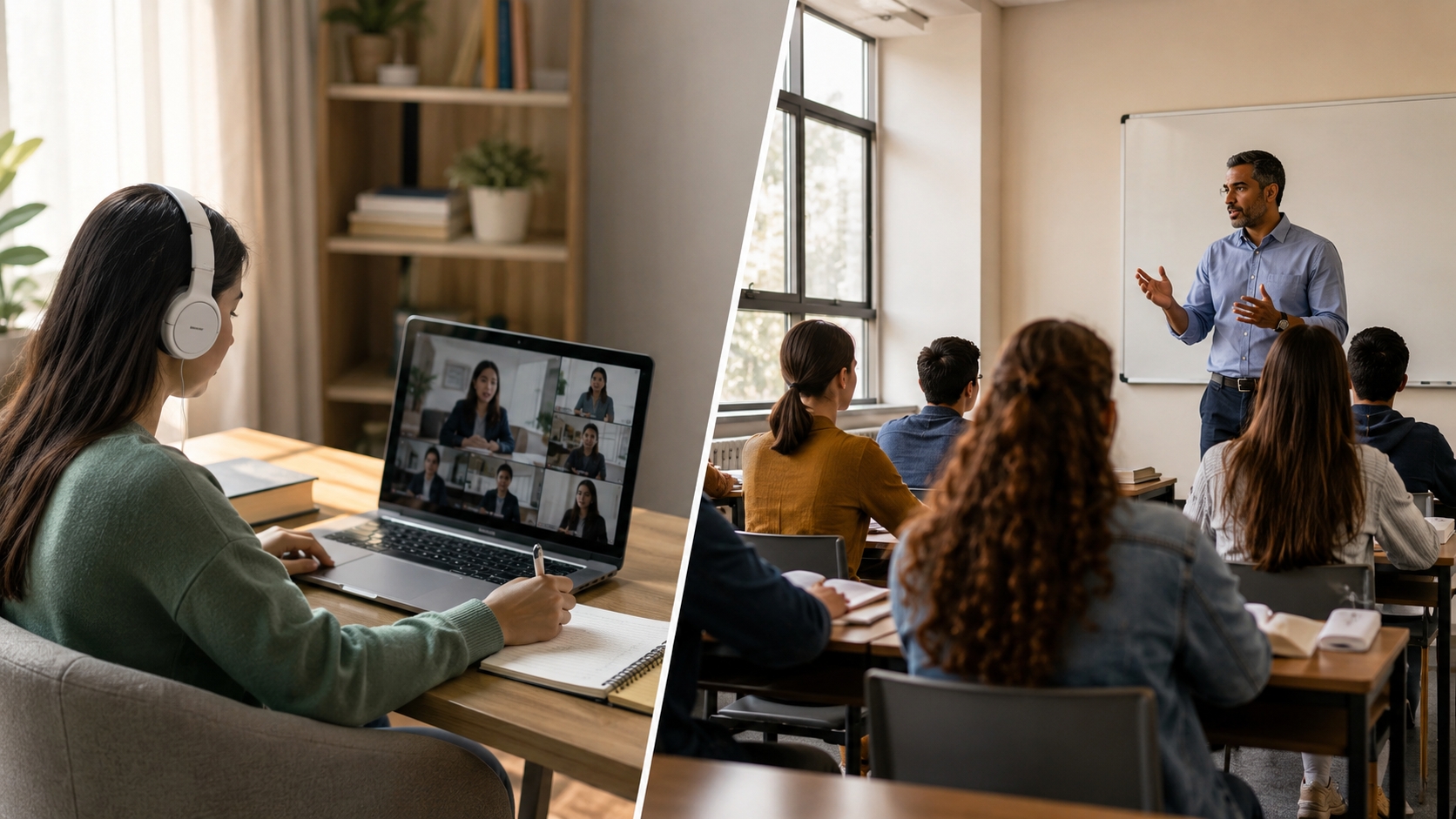
The biggest difference between distance learning and traditional classroom education is the physical separation between the learner and instructor.
| Factor | Distance Learning | Traditional Learning |
|---|---|---|
| Location | Students can usually study remotely | Students generally attend a physical location |
| Schedule | Can be flexible or fixed depending on the course | Usually follows a fixed timetable |
| Communication | Video calls, email, forums and digital platforms | Primarily face-to-face communication |
| Learning materials | Digital and online resources are commonly used | Physical and digital resources may be used |
| Independence | Often requires strong self-management | Classroom structure provides more direct supervision |
| Travel | Usually little or no daily commuting | Students generally travel to the institution |
Neither approach is automatically better for every learner. The right choice depends on the subject, learning style, available technology, schedule, cost, and level of interaction required.
Benefits of Distance Learning
Distance learning has become an important option for students, professionals, educators, and lifelong learners because it can remove geographical and scheduling barriers.

Flexibility
One of the biggest advantages of distance learning is flexibility. Students may be able to choose when and where they study, particularly when a course uses asynchronous or self-paced learning.
This can make education more accessible to people balancing employment, family responsibilities, travel, or other commitments.
If you are interested in developing better study habits and staying consistent with learning, explore our guide to building good and effective habits.
Greater Accessibility
Distance learning can make educational opportunities available to people who cannot easily attend a physical institution because of location, work schedules, mobility limitations, or other circumstances.
Students can potentially study from home or another suitable location as long as they meet the course’s technical and participation requirements.
Accessibility should still be considered when choosing a platform. Check whether the course provides captions, transcripts, keyboard accessibility, alternative formats, readable interfaces, and other features relevant to your needs.
More Learning Opportunities
Online and distance learning can give students access to courses and educational resources from institutions and organizations outside their local area.
For example, learners can explore online courses from universities, educational organizations, professional training providers, and open educational platforms.
UNESCO Open Learning provides online courses covering areas such as education, science, culture, communication, information, and lifelong learning.
Potentially Lower Costs
Distance learning can reduce some costs associated with education, such as commuting, accommodation, and relocation. However, the total cost varies considerably between courses and institutions.
Students should compare the full cost of tuition, technology requirements, textbooks, examination fees, certification fees, and other expenses before enrolling.
Do not assume that an online course is automatically cheaper than a traditional course. Instead, compare the complete cost and the value of the qualification or skills you expect to receive.
Learn From Almost Anywhere
One of the defining characteristics of distance learning is location flexibility. Students can often study from home, a workplace, a library, or another suitable location.
This can be especially useful for learners who live far from educational institutions or who cannot relocate for a course.
Develop Digital Skills
Distance learning often requires students to use digital communication, online research, document-sharing, video conferencing, learning management systems, and other technologies.
As a result, students can develop practical digital skills alongside the subject they are studying.
Challenges of Distance Learning
Distance learning also has limitations. Understanding these challenges can help students choose a course that matches their circumstances.
Self-Discipline and Time Management
Flexible learning requires students to manage their own time. Without regular classroom attendance, it can be easier to postpone assignments or fall behind.
Creating a realistic study schedule, setting weekly goals, and maintaining a consistent learning routine can help.
Limited Face-to-Face Interaction
Some learners prefer direct, face-to-face interaction with teachers and classmates. Although video conferencing, discussion forums, messaging, and collaborative tools can provide interaction, they do not always reproduce the experience of a physical classroom.
Technology Requirements
Reliable internet access, a suitable device, appropriate software, and basic digital skills may be necessary for many distance learning courses.
Before enrolling, check the technical requirements carefully. A course that requires live video sessions may have different requirements from a self-paced text-based course.
Quality Varies Between Courses
Not every online course provides the same level of teaching, support, assessment, or recognition.
Before enrolling, investigate the institution or course provider, instructor qualifications, curriculum, student support, assessment methods, reviews, and accreditation or recognition where relevant.
How to Choose a Distance Learning Course
Choosing the right distance learning course requires more than comparing course titles. Consider the following factors before enrolling.
1. Course Quality
Review the curriculum, learning objectives, instructor information, sample materials, assessments, and student support available.
2. Accreditation and Recognition
If you need a qualification for employment, further education, licensing, or professional development, verify who recognizes the qualification.
A certificate of course completion is not necessarily equivalent to an accredited academic qualification. Always check the exact credential awarded by the institution.
3. Course Schedule
Determine whether the course is synchronous, asynchronous, self-paced, or hybrid.
Ask yourself:
- Are live classes required?
- Are there fixed deadlines?
- How many hours per week are recommended?
- Can recorded lessons be watched later?
- Are examinations held at fixed times?
4. Learning Platform
A good distance learning platform should be easy to navigate and provide the tools required for the course.
Depending on the subject, useful features can include:
- Video lessons
- Discussion forums
- Digital learning materials
- Assignment submission
- Online assessments
- Instructor communication
- Progress tracking
- Mobile compatibility
- Accessibility features
5. Student Support
Find out how students can receive help. Some courses provide dedicated tutors, instructors, technical support, academic advisers, discussion forums, or peer communities.
Strong support can make a significant difference, particularly for learners who are new to online education.
Tips for Succeeding With Distance Learning
Distance learning gives you flexibility, but that flexibility works best when combined with a consistent learning routine.

- Create a regular study schedule: Set specific periods for lessons, reading, assignments, and revision.
- Set realistic weekly goals: Break large courses and assignments into smaller tasks.
- Minimize distractions: Use a dedicated study environment whenever possible.
- Participate actively: Ask questions and contribute to discussions instead of passively consuming lessons.
- Take notes: Writing down key ideas can improve understanding and make revision easier.
- Use multiple learning formats: Combine reading, videos, practice activities, discussions, and projects where appropriate.
- Track your progress: Regularly check whether you are meeting your course goals.
- Ask for help early: Contact instructors or support teams before a small problem becomes a major setback.
For more ideas, see our guide to effective learning methods and our article on ways to learn faster.
Distance Learning Resources and Platforms
There are many ways to continue learning online. The best option depends on whether you want an academic qualification, professional development, a new skill, or informal learning.
For a broader list of online education resources, see our guide to 21 amazing sites for online education.
For additional authoritative information about distance learning, The Open University explains how distance learning works, while UNESCO Open Learning provides access to online educational resources and courses.
Frequently Asked Questions About Distance Learning
What is distance learning in simple words?
Distance learning is education that allows students to study without being physically present in the same classroom as their teacher. Lessons and communication can take place through online platforms, video conferencing, digital materials, email, and other technologies.
Is distance learning the same as online learning?
They are closely related but are not always identical. Online learning specifically uses internet-connected technologies, while distance education can include other methods such as printed materials, correspondence, television, radio, or other communication technologies.
Is distance learning good for students?
Distance learning can be effective for students who value flexibility and can manage independent study. Its suitability depends on the learner, subject, course design, instructor support, technology access, and assessment requirements.
What are the main types of distance learning?
The main formats include synchronous learning, asynchronous learning, self-paced courses, scheduled online courses, computer-assisted learning, and hybrid or blended learning.
What are the biggest benefits of distance learning?
Common benefits include flexibility, location independence, wider access to educational opportunities, potentially lower indirect costs, and opportunities to develop digital skills.
What are the disadvantages of distance learning?
Common challenges include the need for self-discipline, reduced face-to-face interaction, technology requirements, isolation for some learners, and differences in course quality and recognition.
Can distance learning lead to a recognized qualification?
Yes, some distance learning programs lead to recognized certificates, diplomas, degrees, or professional qualifications. However, recognition varies by institution, country, qualification, and program, so students should verify the credential before enrolling.
Final Thoughts
Distance learning has transformed the way people can access education. Instead of requiring every student to travel to a physical classroom at a fixed time, modern distance education can combine live instruction, recorded lessons, digital resources, online communities, assessments, and self-paced study.
The flexibility can be particularly valuable for working professionals, lifelong learners, students with geographical limitations, and anyone who needs a learning schedule that fits around other responsibilities.
However, distance learning is not automatically the right choice for everyone. Before enrolling, compare the course structure, schedule, cost, technology requirements, student support, assessment methods, and qualification recognition.
When the course and learning format match your goals and circumstances, distance learning can provide a practical pathway to develop new knowledge, improve professional skills, earn qualifications, and continue learning throughout life.
Continue learning: Explore online education websites | Learn effective learning methods | Build better learning habits